Navigation LevelsSEEKERS offers three navigation levels so you can train step by step instead of starting directly with full rally navigation.
A practical way to progress is to use the same route with increasingly less guidance. First learn the line, then learn the timing, and finally learn to read the roadbook without depending on map-style navigation. | 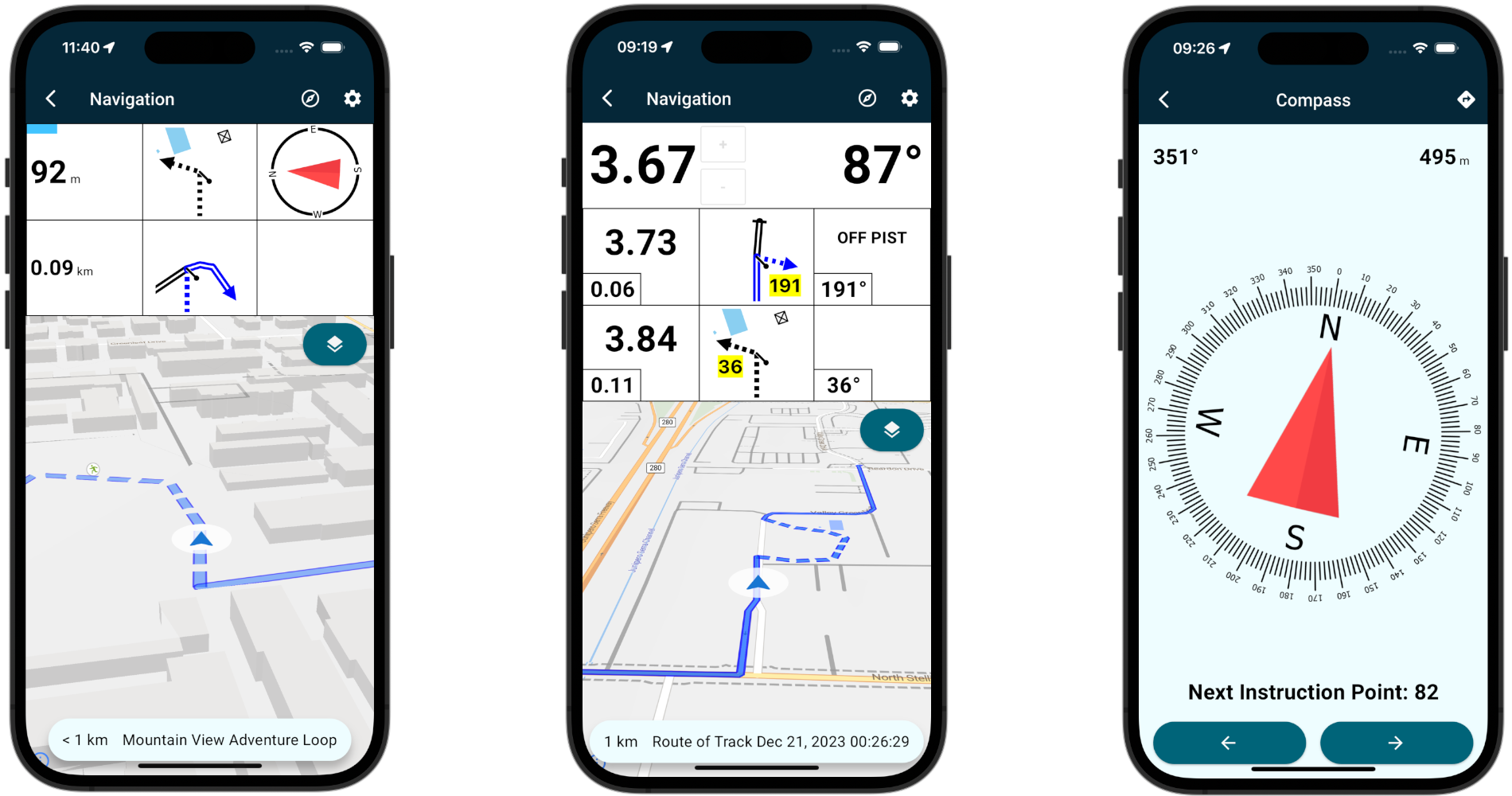 |
Navigation Levels
SEEKERS offers three navigation levels so you can train step by step instead of starting directly with full rally navigation.
- Level 1: Turn-by-turn navigation. This is the easiest entry point. SEEKERS shows a small diagram, the so-called tulip, for each maneuver. The objective is to map that diagram to the real world quickly and keep moving.
- Level 2: Rally mode with total trip, tripmaster and CAP. This level adds distance discipline and heading control. Each note gives a total kilometer, the partial distance counts down to the next note, and the CAP helps you hold the right direction.
- Level 3: Full rally navigation with roadbook, tripmaster and CAP. This is the classic rally setup. The roadbook becomes the main source of information and each maneuver has to be interpreted correctly and on time, often with only one quick glance.
A practical way to progress is to use the same route with increasingly less guidance. First learn the line, then learn the timing, and finally learn to read the roadbook without depending on map-style navigation.
Rally Navigation in DetailRally navigation is all about timing. The goal is to get all the information for the next maneuvers in as little time as possible: look when you have time, memorize the next maneuvers, and act at the right moment. A rally roadbook gives only the information needed for the next moves, so flow and rhythm matter more than staring at a map. In SEEKERS, rally navigation means working with three key instruments: 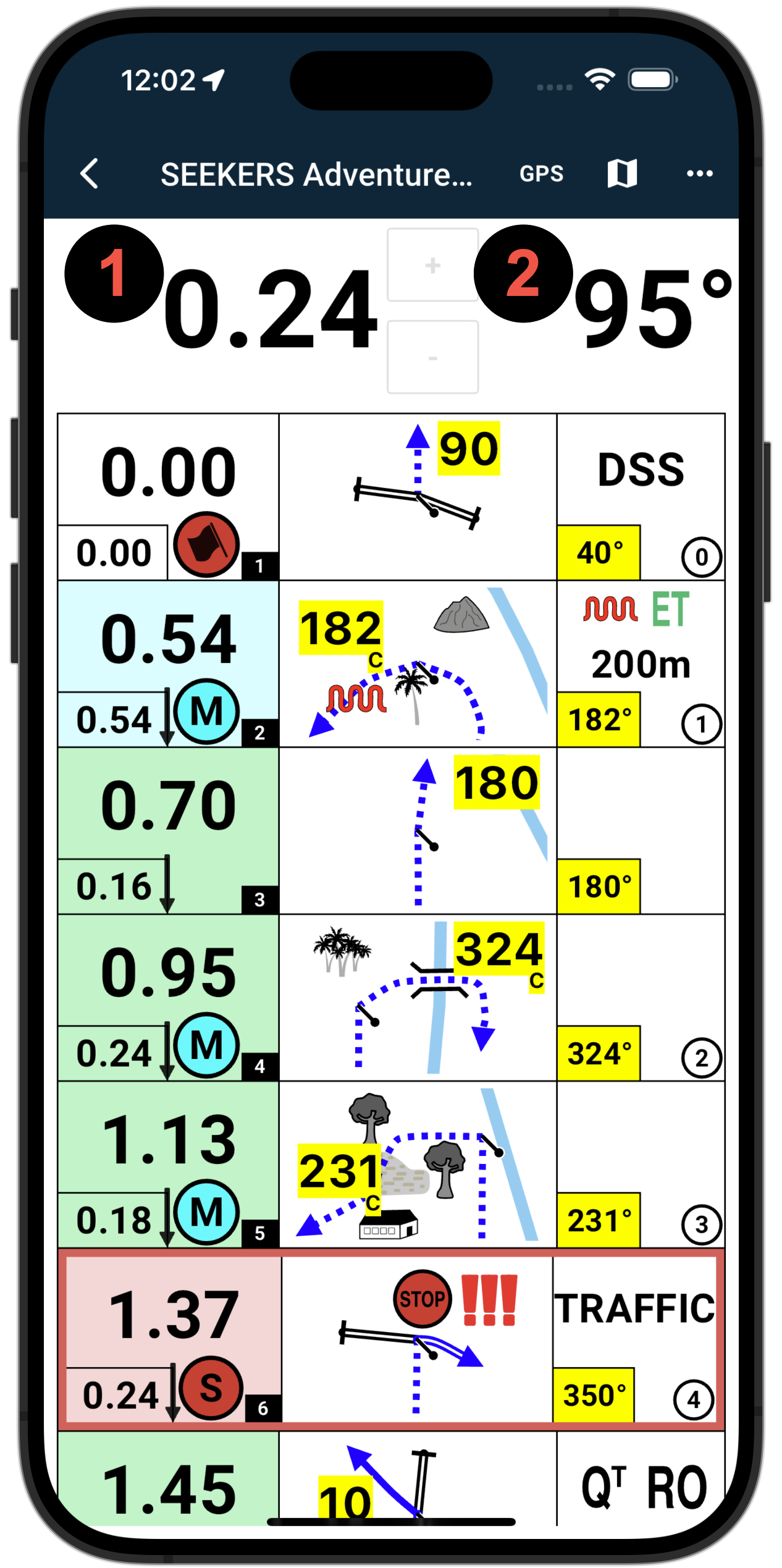
SEEKERS also supports connected hardware buttons via Bluetooth so you can scroll the roadbook and adjust the tripmaster while riding. If you prefer, you can enable auto-scroll so the next note is shown automatically after leaving the radius of the current note. The training idea behind the app is simple: first use the tulips like turn-by-turn instructions, then rely on tripmaster and CAP, and finally remove the map and navigate only with roadbook, tripmaster and heading. SEEKERS implements the FIA/FIM sporting regulations 2026. | |
Rally Navigation in Detail
Rally navigation is all about timing. The goal is to get all the information for the next maneuvers in as little time as possible: look when you have time, memorize the next maneuvers, and act at the right moment. A rally roadbook gives only the information needed for the next moves, so flow and rhythm matter more than staring at a map.
In SEEKERS, rally navigation means working with three key instruments:
- The tripmeter or tripmaster shows the distance. Adjust it when you are certain you are passing a known note or waypoint.
- The CAP heading shows your current direction from 0° to 360° and helps you stay precise when the terrain offers multiple options.
- The roadbook gives the sequence of notes, waypoint information, hazards, controls and speed information.
SEEKERS also supports connected hardware buttons via Bluetooth so you can scroll the roadbook and adjust the tripmaster while riding. If you prefer, you can enable auto-scroll so the next note is shown automatically after leaving the radius of the current note.
The training idea behind the app is simple: first use the tulips like turn-by-turn instructions, then rely on tripmaster and CAP, and finally remove the map and navigate only with roadbook, tripmaster and heading.
SEEKERS implements the FIA/FIM sporting regulations 2026.
FIA Sporting Regulations (external link)
FIM Sporting Regulations (external link)
The RoadbookA roadbook is the core document of a rally stage. It combines route logic, waypoint order, hazards and control information in a compact form that must be read quickly while moving. Each roadbook consists of many notes. Every note describes one navigation situation and helps the rider stay on the intended route without needing a conventional map display. 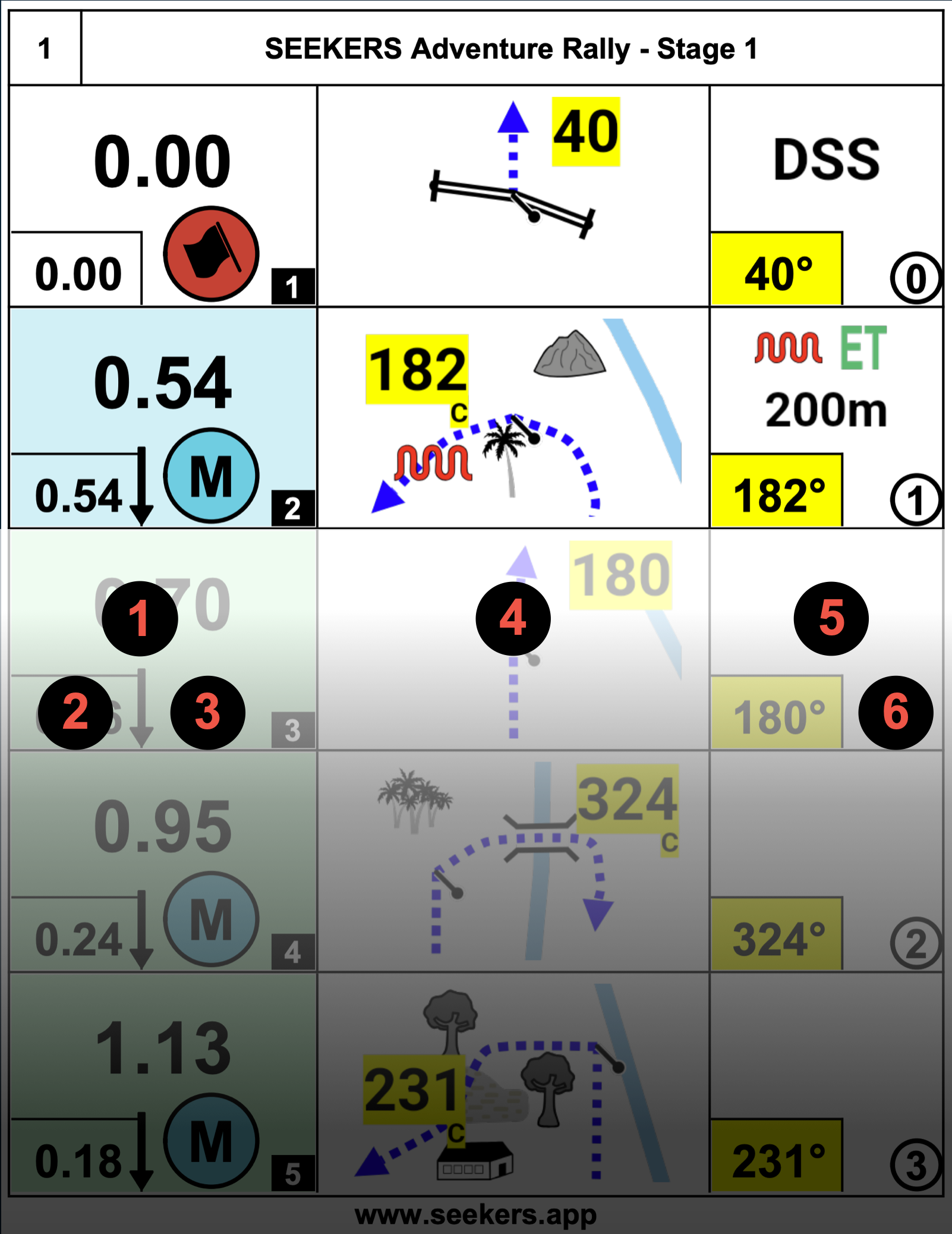 Elements of a roadbook note:
SEEKERS can automatically generate an initial training roadbook from a route. In off-road sections, significant direction changes become masked waypoints. Smaller direction changes can become CAP notes. On roads, turns and verification notes are generated to keep the navigation readable. All icons, symbols and abbreviations are explained in the Roadbook Lexicon. | |
The Roadbook
A roadbook is the core document of a rally stage. It combines route logic, waypoint order, hazards and control information in a compact form that must be read quickly while moving.
Each roadbook consists of many notes. Every note describes one navigation situation and helps the rider stay on the intended route without needing a conventional map display.
Elements of a roadbook note:
- Distance box with the total distance at the note.
This box is highlighted with a green background, if the distance from the previous note to this note is less than 300 m.
- Partial distance from the previous note.
An arrow down is displayed beside this box, if the distance to the next note is less than 300 m.
- Placeholder for the waypoint icon.
- Diagram box with the tulip and relevant symbols.
- Description box with short written information, warnings or speed limits.
- Placeholder for the waypoint number.
SEEKERS can automatically generate an initial training roadbook from a route. In off-road sections, significant direction changes become masked waypoints. Smaller direction changes can become CAP notes. On roads, turns and verification notes are generated to keep the navigation readable.
All icons, symbols and abbreviations are explained in the Roadbook Lexicon.
Waypoint Validation
The goal of each selective section is to reach all waypoints in the correct order. The waypoints are marked in the roadbook with a waypoint icon.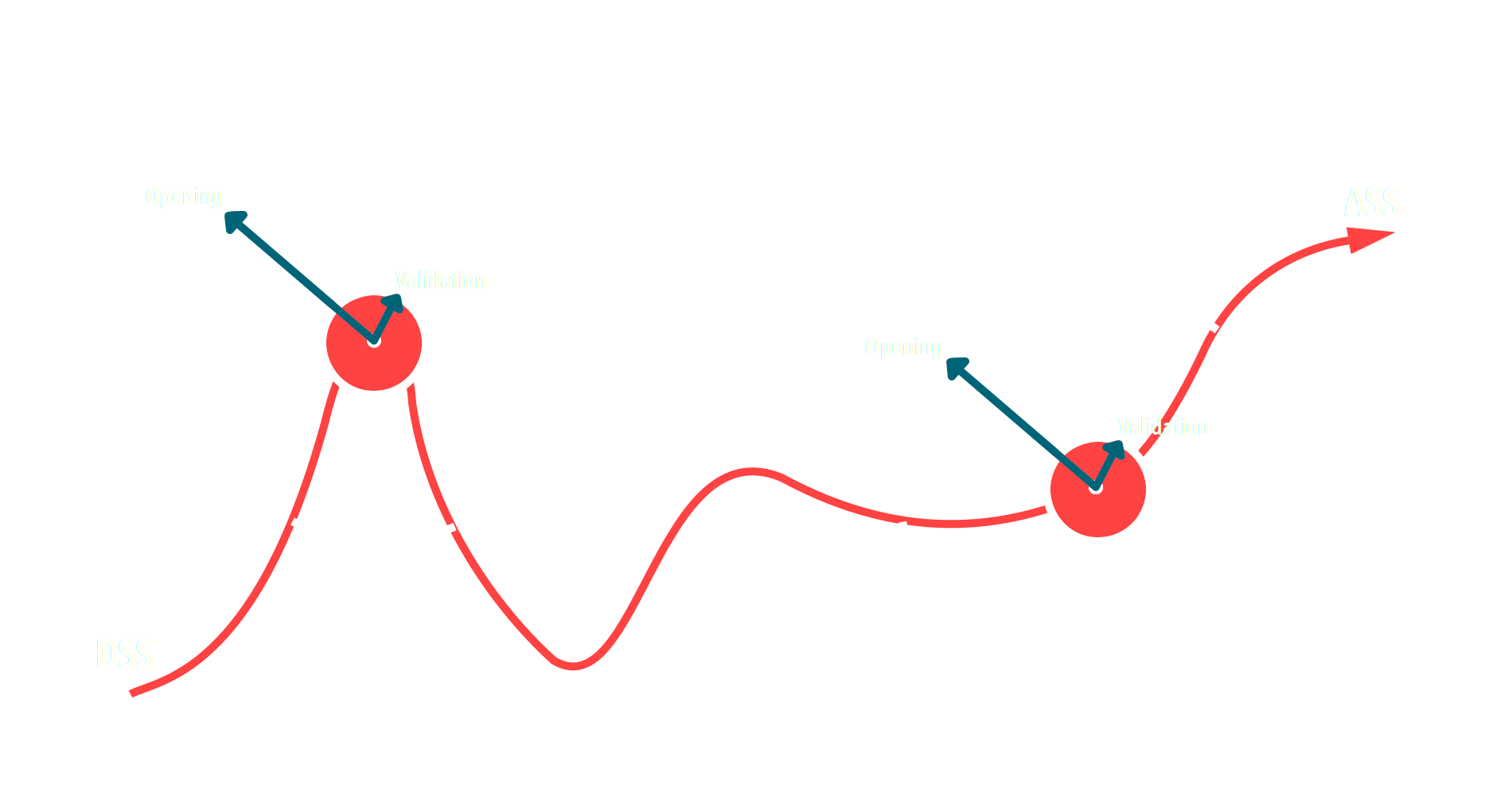
SEEKERS GPS only guides you to a waypoint when you are within its opening radius. To validate a waypoint, you must come within its designated validation radius. If the preceding waypoint was not validated, the last waypoint is considered as missed.
Specific radii and penalties are detailed in the following table:
| Waypoint Symbol | Waypoint Type | Opening Radius | Validation Radius | Penalty |
|---|---|---|---|---|
 | Masked Waypoint (WPM) | 800m | 90m | 15 minutes |
 | Control Waypoint (WPC) | Never | 300m | 15 minutes |
 | Safety Waypoint (WPS) | 1000m | 30m | 15 minutes |
 | Navigation Waypoint (WPN) | 800m | 200m | 60 minutes |
 | Precise Waypoint (WPP) | 100m | 20m | 2 minutes |
 | Visible Waypoint (WPV) | Always | 200m | 15 minutes |
 | Eclipse Waypoint (WPE) | Prev (1000 m)* | 90m | 15 minutes |
 | Passage Control (CP) | Prev (1000 m)* | 90m | 15 minutes |
 | Departure Selective Sector (DSS) | Prev (1000 m)* | 200m (25m start radius) | Stage Penalty |
 | Arrival Selective Sector (ASS) | 800m | 90m | Stage Penalty |
 | Departure Zone (DZ) | (1000m) Prev** | 90m | 15 minutes |
 | Finish Zone (FZ) | Prev (1000 m)* | 90m | 15 minutes |
  | Departure Neutralization (DN) / Departure Transfer (DT) | (1000m) Prev** | 90m | Stage Penalty |
  | Finish Neutralization (FN) / Finish Transfer (FT) | Prev (1000 m)* | 90m | Stage Penalty |
* Prev (1000 m): Previous waypoint or within 1000 m if the previous waypoint was missed.
** (1000 m) Prev: Within 1000 m or previous waypoint by the shortest distance.
Start and Finish of a Stage
DSS marks the start of the selective sector and ASS marks the finish. Missing these controls leads to a stage penalty because the timed section cannot be evaluated correctly.
Enter the start radius (25m radius of the DSS waypoint) 60s before your start time. The current time will be displayed on top of the roadbook as soon as you have entered the start radius.
As soon as you pass the 25m line after the start waypoint (DSS) the time counts. You can leave the start radius as often as you want and come back, as long as you have not validated the first following waypoint. The last passage of the 25m line after the DSS waypoint is taken as the start time.
The clock stops as soon as you have passed the 90m line before the ASS waypoint. As soon as you enter the 25m line of the ASS waypoint, your result will be submitted.
Penalties and Neutralization / Transfer Zones
SEEKERS follows the logic of the 2026 FIA / FIM rally regulations for waypoint handling, speed control and restart logic. The route remains secret until the roadbook and navigation system are distributed, and the route is respected by validating the waypoints in chronological order.
Missed Waypoints
Each waypoint type has its own validation radius and penalty. If a waypoint is not validated in order, it is counted as missed. In SEEKERS, waypoint penalties are derived from the waypoint type configured in the roadbook. Between compulsory points of passage, the roadbook remains the recommended itinerary; the waypoints guarantee that the official line is respected.
Neutralization and Transfer Zones
DN to FN defines a neutralization zone. DT to FT defines a transfer zone. In these sections, the competitive stage is interrupted and restart logic applies instead of normal stage progression.
According to the FIM regulations, a neutralization is a stopped phase under parc ferme conditions and the neutralization time is identical for all competitors. A transfer is a road section with a fixed transfer time between two parts of the selective section.
- Enter the zone at DN or DT and follow the information shown in the roadbook and on the device.
- The restart time is attached to the opening waypoint of the zone. Given with T:MM:SS in the description box of the waypoint.
- In a transfer zone, the ideal restart time is based on the finish time of the previous section plus the defined transfer time.
- The timing of neutralization and transfer zones is managed by the GPS, but the rider remains responsible for starting at the correct time.
- At FN or FT, the rider waits in front of the start sign, may enter the validation radius up to 60 seconds before the assigned start time, and then proceeds to the line for the electronic restart (25m radius of the FN / FT waypoint).
- At the end of a neutralization zone there is no separate time control. The restart procedure itself defines the continuation of the stage.
- In SEEKERS, missing waypoints inside neutralization or transfer zones are excluded from standard waypoint penalties.
- If a rider leaves late, the FIM rules still treat the rider as having started on time. If a rider leaves early, penalties apply.
Speed Zones
DZ and FZ waypoints are used for speed-controlled zones. The entry point has a 90 meter deceleration tolerance area and the exit point has a 90 meter acceleration tolerance area. Overspeeding is evaluated in pulses according to the FIM logic used by SEEKERS.
- A pulse is recorded every 150 meters or every 10 seconds of continuous overspeeding, whichever comes first.
- 1 to 5 km/h above the limit: 10 seconds per pulse.
- 6 to 15 km/h above the limit: 1 minute per pulse.
- 16 to 40 km/h above the limit: 2 minutes per pulse.
- More than 40 km/h above the limit: 6 minutes per pulse.
In practice, this means that accurate navigation is not only about finding the route. It also means validating the correct waypoints, respecting restart procedures and managing speed precisely through controlled zones.
Groups, Results and Ranking
SEEKERS is not only a navigation tool for solo riding. The app is built around groups of users so routes, places and results can be shared in a controlled way for training rides and events.
In practical terms, a group works as a shared event space:
- Group members can receive access to routes and places through the group.
- Group admins can enable a competition mode for a certain route inside the group.
- Each rider submits a result for the route, including track, timestamps and waypoint validations.
- Results are linked to the group channel so they can be compared inside the same event context.
This also matches the protected sharing approach, routes can be shared only with defined users or groups, and access can be removed again after the event.
Competition Modes
SEEKERS supports group competitions. Group admins can enable a competition mode for a specific route and compare the submitted results of all group members in a shared ranking.
Quick links:
Precise Navigation Challenge
This is the rally simulation mode. The goal is not only to validate waypoints, but also to stay precise, keep your rhythm, and avoid unnecessary distance. It is designed as a slow-motion training mode for rally riding, where accuracy matters more than outright speed.
- Navigation accuracy is measured against the route. Each additional 50 meters counts as 1 point.
- The comparison is based on a 50-meter route corridor so inner and outer line variations remain comparable and normal GPS inaccuracies are reduced.
- Standstill time adds pressure at each maneuver and scores 10 points per minute outside neutralization zones.
- Missed waypoints are penalized with the corresponding waypoint penalty multiplied by 10. A missed WPP therefore costs 20 points, while a missed WPM costs 150 points. For example to reach a WPP (2min penalty) it makes sense to take a detour < 1km. This is like riding 30km/h in a rally and taking a detour of 1km.
- If a neutralization or transfer time applies, early departure will give a penalty of 1min + the time of the neutralisation (FIM regulation for first attempt). For the Precise Navigation Challenge this is taken as 1 min = 1 point.
- Overspeeding in speed-controlled zones is penalized according to the pulse-based FIM logic. For the Precise Navigation Challenge this is taken as 1 min = 10 points.
The rider with the lowest total score wins. This makes the mode ideal for training precise navigation flow instead of simply chasing speed.
Navigation Challenge
This mode focuses on waypoint collection and route discipline. It is a simple and effective format for group rides and club events because it rewards correct navigation without turning the day into a pure race against the clock.
- Time is not considered for the ranking.
- Each kilometer of the stage counts as 2 base points.
- Missing waypoints are penalized according to the waypoint type.
- The final score is the sum of the route points (static) and waypoint penalties.
- Missing waypoints inside neutralization or transfer zones do not count.
The participant with the lowest total score wins.
Time Trial
This is the rally race format. The decisive factor is total time, but the final ranking still depends on respecting the roadbook, validating waypoints and following the zone rules.
- The ranking is based on driving time plus time penalties.
- Missed waypoints are penalized according to FIA / FIM logic and the configured waypoint penalties.
- In neutralization or transfer zones, waypoints do not count as missed and the rider must restart at the assigned time.
- Early departure from a neutralization or transfer zone leads to a restart-related penalty.
- Overspeeding in speed-controlled zones is penalized according to the pulse-based FIM logic.
This mode is the closest to classic rally timing and is the right choice if the event should primarily reward the fastest complete ride.


© SEEKERS® by Janiko Naber